

NovaSpeed reads every run-up back from the board or the box
The laser stands behind the start of the runway and follows the jumper down it. You measure the board or the box at the start of the session, and every run-up after that is shown in metres before it: the top speed, where it came, and whether the athlete held it or slowed down.
Set up as for a sprint, then measure the board or the box
- 1
Put the tripod about 2 m behind the start of the run-up
Line it up with the runway, set the unit at about hip height (0.8 to 1.0 m), level it and point it down the middle of the runway.
- 2
Aim at the take-off end first
Turn the knobs on the geared head until the dot is on the board or the box, then check the dot again with the athlete at the start of the run-up.
- 3
Measure the board or the box
Pick Long jump or Pole vault run-up for the session. Then have someone stand on the take-off board, or at the back of the box, facing the pit with the laser on their back, and tap Measure. You can also type a taped distance. If you move the tripod, measure again.
- 4
Jump as usual
Recording starts by itself when the athlete sets off from a standing start, and you press Record for a walk-in start. A long jump recording ends at the board, and a vault ends at the take-off.
Take-off spots change from jump to jump. The board and the box don't.
Counting back from a fixed line lets you compare run-ups from one day to the next, and between athletes. The stretches end before the take-off, so they sit in the same place on every jump.
In long jump, the app follows the run-up to the board
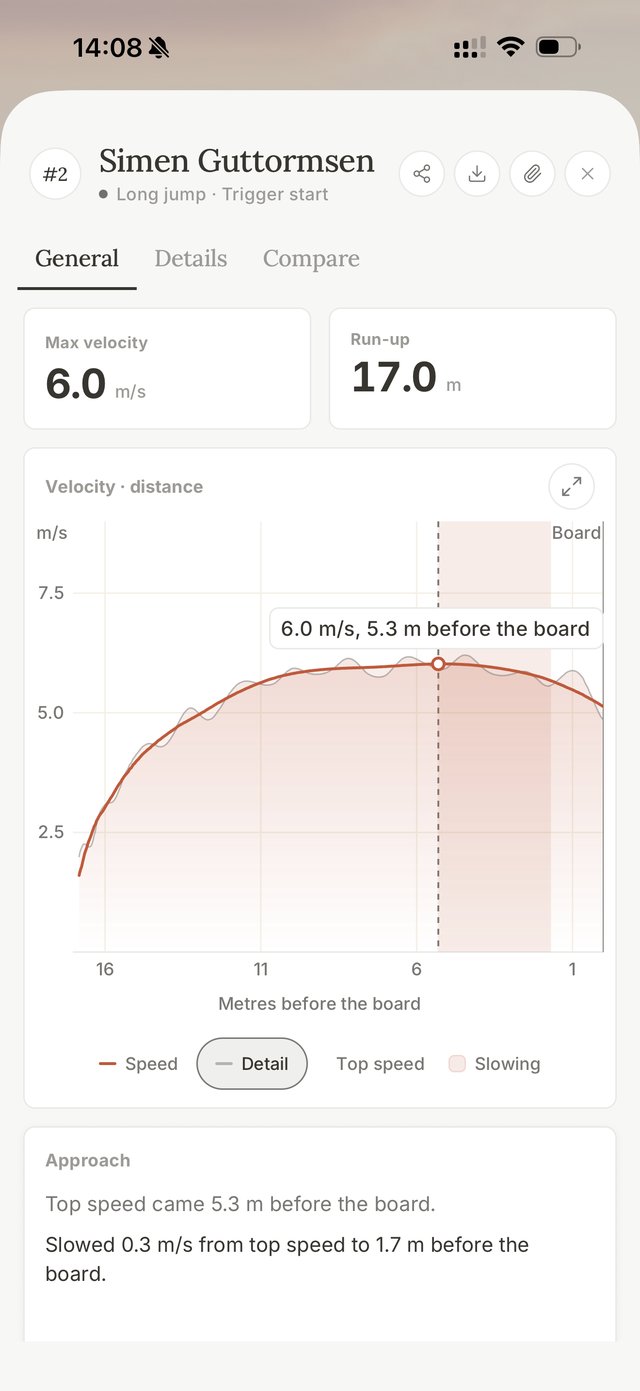
Top speed is the fastest half second of the run-up before the board, and the app says how many metres before the board it came. The speed curve is drawn in metres before the board. If the athlete slowed down by 0.3 m/s or more, the app says by how much and shades that part of the curve.
- Top speedThe fastest half second of the run-up before the board
- Where it cameIn metres before the board
- Run-upFrom the start of the run-up to the board
- Held or slowedFor example: Slowed 0.3 m/s from top speed to 1.7 m before the board
- Two 5 m stretches11 to 6 m and 6 to 1 m before the board, timed line to line, and the change between them, on the Details tab
What happens after the board (the take-off, the flight and the landing) is different for every athlete, so the app records it but never uses it for a number. In the web app you can also log the distance of each jump.
In pole vault, the run-up is read back from the box
The vault works the same way, with the back of the box as the line. You see the top speed and where it came, the run-up, whether the vaulter held their speed, and two 5 m stretches that both end before the take-off.
A vault recording ends by itself at the take-off. NovaSpeed started with a pole vault run-up: Simen wanted to see the speed of his whole approach, not just a time between two gates. Read how it started.
- Top speedThe fastest half second of the run-up
- Where it cameIn metres before the box
- Run-upFrom the start of the run-up to the box
- Held or slowedWhether the vaulter held their top speed or slowed down
- Two 5 m stretches15 to 10 m and 10 to 5 m before the box, timed line to line, and the change between them, on the Details tab
- Make or missWith the bar height, logged by hand in the web app
Long jump and pole vault are ready in the app today
Pick the event when you start a session, measure the line, and every run-up is saved with its numbers.

Tell us about your jumpers
Say which events you coach and how many athletes jump. We'll reply with availability and a quote.